We are very fortunate in that at the Forest Gate Hotel, which is a pub that is just around the corner from where we live, on the last Friday of every month, we are treated to a free evening of country, folk and blues music. The events includes a main act, plus the resident Flats Family Band and various guests and surprise musicians. The events are called Forest Roots. For more information about the events and/or if you want to perform, contact forestroots@gmail.com.
At the next one, which is this Friday, 23rd July, our son, Victor Rikowksi, will be playing a couple of numbers, which will include one of his own compositions.
To find out more about Victor's band and listen to their music see:
http://rikowski.wordpress.com/cold-hands-quarter-moon/
Cold Hands & Quarter Moon profile on MySpace:
http://rikowski.wordpress.com/cold-hands-quarter-moon/
Some of their songs are also on YouTube - www.youtube.com
Also, Victor’s PowerPoint story (in 6 parts), The Ockress, can be found at: http://www.theockress.com
Acoustica are the headline band at Forest Roots this Friday. They play a varied selection of Irish folk and modern acoustic music. There will also be the resident Flats Family band, and various other guest and surprise musicians, including a couple of songs from the Forest Voices Choir, which I am a member of.
Jenny Beeching runs both Forest Voices and Forest Roots.
So come along to Forest Roots on Friday, 23rd July!
It starts 8.30pm at the usual venue:
The Forest Gate Hotel Function Room, Godwin Road, Forest Gate.
Free entry (with a whip-round)
Wednesday, 21 July 2010

Thursday, 15 July 2010
Forest Gate Carnival
The Forest Gate Carnival, a yearly event which takes place about 5 minutes from our home took place a couple of weeks ago (on 10th July 2010). It was a lovely, hot and sunny day. There were plenty of stalls, people, singing and dancing. The choir that I am in, Forest Voices sang a few songs, including singing some songs with Godwin Road School Choir (see first picture below); all led by Jenny Beeching. All in all, it was a very enjoyable event. There was even a Tea Dance at the church at the top of the road.


Saturday, 10 July 2010
'Highland Fling' by Katie Fforde

I wanted a bit of light relief from Sartre for a while, so decided to read 'Highland Fling' by Katie Fforde. It proved to be a pleasant read.
Jenny Porter, a 'Virtual Assistant' goes off to Scotland to sort out a failing mill for one of her clients. When she arrives she is more determined than ever to save it. But she is very attracted to Ross Grant, which doesn't help because Dalmain Mill owes him a lot of money. Also, Lady Dalmain is domineering and over-powering, to such an extent that her son Philip walks out on her and her mill.
Anyway, in the end, Jenny (moving on from Henry) and Ross come together (they just can't resist each other) and Ross says that he will do all that he can to try to save the mill. So, everyone ends up reasonably happy.
Tuesday, 6 July 2010
'The Age of Reason' by Jean-Paul Sartre

Next, I decided to read Jean-Paul Sartre's trilogy, 'The Roads to Freedom'. The BBC did a brilliant serialisation of this years ago, and although it had a very profound effect on me, I never actually got to read the books. I decided that it was time to rectify that. The first of the three books is entitled 'The Age of Reason',(Penguin, London, 1961; originally published in hardback in 1945), and so obviously, that is where I began.
The development of Sartre's thinking, the sophistication of his novel-writing is very marked. 'The Age of Reason' is just such a better and more engaging read than 'Nausea' (and he wrote this book only just 7 years after writing 'Nausea'). Philip Kerr is certainly praise-worthy of the book, saying "For my money...the greatest novel of the post-war period". Well, that was something of an exaggeration, in my view, but still it was a good book. And of course, what is so important and special about Sartre's work is that he wrote both non-fiction and fiction, and decided presumably, that some of his philosophical ideas and messages could be conveyed more effectively (or at least the contradictions could be expressed better) through the novel than through non-fiction writing. A shame that Nietzsche did not arrive at the same conclusion; the world would have been better off for that.
The big philosophical issue that Sartre addresses in this book, involves his wish and aim to somehow marry up Existentialism with Marxism. Not that he does marry it up in the book, but this just, in itself, illustrates how difficult it is to do this. Indeed, perhaps, it is impossible. Which is precisely why the topic had to be addressed in a novel. A good non-fiction, academic and worthy work requires consistency of thought; now that is very difficult achieve, if not impossible, with this topic. But never-the-less the topic is of earth-shattering importance, in my view. I am becoming very close to agreeing with Sartre here, although I started off more clearly from the Marxist perspective, whereas Sartre started from the existentialist perspective. (although, in another sense, I guess that many of us, when growing up in particular, crave for freedom in some way).
Anyway, to turn to the plot. The main character in the book, Mathieu Delarue, is living an existential-type of existence. But within this, his long-term partner Marcelle falls pregnant. Having the baby would disrupt Mathieu's life, and indeed, the free, existential life that he wants to continue to live, so he wants her to have an abortion. But Mathieu can't find the necessary cash for it. Neither is Marcelle necessarily 100% happy about having an abortion anyway. Somewhat ironically, Daniel, the gay character in the book, tries to talk her out of it, and even offers to marry her so that she can have the baby. Then Mathieu thinks that perhaps he should marry her himself, even though the person that he is actually in love with is Ivich.
Mathieu is a philosophy teacher, and the whole book is set around just 2 days, with Mathieu walking about, going into the cafes and bars of Montparnasse, talking to friends on various topics whilst also trying to obtain the money. His friends, for example, think that he wants to be free:
"Only, he wants to be free, just as other people want a collection of stamps. Freedom, this is his secret garden: a little scheme with himself as sole accomplice...An idle, unresponsive fellow, rather chimerical, but ultimately quite sensible, who has dexterously constructed an undistinguised but solid happiness upon a basis of inertia, and justified himself from time to time on the highest moral grounds. Is that what I am?", asks Mathieu. (p. 49)
Whilst all this is going on he ia also approached and asked if he would like to join the Communist Party. His instinct tells him 'no', although he does consider it, but then rejects it. It would inhibit his freedom too much (and this is where the Existentialist/Marxist dilemma is addressed). Here are some of Mathieu's thoughts on the matter:
"I refused because I want to remain free: that's what I can say. And I can also say - I got the wind up. I like my green curtains, I like to take the air in the evening on my balcony, and I don't want any change. I enjoy railing against capitalism, and I don't want it suppressed, because I should no longer have any reasons for so doing. I enjoy feeling fastidious and aloof. I enjoy saying no, always no, and I should be afraid of any attempt to construct a finally habitable world, because I should merely have to say - Yes, and act like other people. From above or below: who would decide?" (p. 124)
Then, a bit later a few more thoughts on the matter, this time from Mathieu's friend, Boris:
"...in the philosophy class there had been a a good deal of lively interest in Communism, and Mathieu had evaded the issue by explaining what freedom was. Boris had promptly understood: the individual's duty is to do what he wants to do, to think whatever he likes, to be accountable to no one but himself, to challenge very idea and every person. Boris had constructed his life on this basis, and he kept himself conscientiously free: indeed, he always challenged everyone, excepting Mathieu and Illich: that would have been futile, for they were above criticism. As to freedom, there was no sense in speculating on its nature, because in that case one was then no longer free." (p.138)
Sartre led much of his personal life in a free, existentialist-type of way, and indeed, had many lovers, and was also deceitful in the process. And of course, living such a way can lead to one hitting up against many and various problems, as well as probably hurting various people in the process. The existentialist is supposed to be responsible for their actions, but all that is very difficult of course. And so we run up against these types of problems. Marxism, on one level can seem to overcome some of them, not on another level, I don't think it can. Still, some of these issues can be addressed in fiction as I say, so that's great.
Finally, Mathieu realises that he has entered 'The Age of Reason'.
Monday, 28 June 2010
Folk Festival at Leigh-on-Sea
On Sunday, 27th June, Glenn, Gregory and I went to the Leigh-on-Sea Folk Festival - see
http://www.oldleigh.com/folkfestival.html.
It proved to be a lovely day out. Folk singing and dancing was going on all day, and the weather was wonderful as well - really hot (well, bit too hot, but shouldn't complain).
England were playing against Germany in the World Cup in the afternoon though of course, so Glenn and Gregory insisted in going off to the pub to watch it. Still, while it was going on, I went off and had a nice cup of tea in a cafe and got talking to 2 ladies who turned out to be librarians, who had cycled from London to the event - how about that for a coincidence. I was sitting there reading through some draft work of mine, and making some notes. They were curious about what I was doing, and that led to the conversation!
I even went for a paddle, participated in a country dance, and bumped into a friend. Oh yes - and there were some people there performing Salsa dancing, so Glenn and Gregory could see what that was all about. Their favourite dance though was the Flamenco dancing - very pretty.
We found out about it all, as we wanted to see the Kittiwakes perform again. We first saw them at 'Forest Roots' - a free folk music event at our local pub and then we discovered that they were playing at this festival.
This Leigh-on-Sea event is also free - amazing. Such talent; such variety; such colour; such enthusiasm. Definitely something that we would recommend - a yearly event, on for 2 days.
And here are some photos of it all.
 The Kittiwakes

The Kittiwakes
 The Kittiwakes


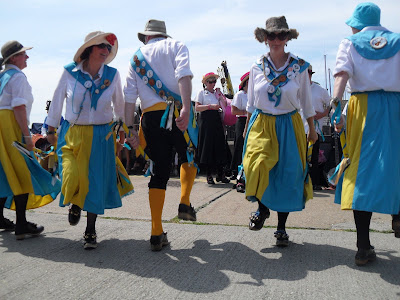


 Flamenco dancing

Flamenco Dancing
 Salsa Dancing


Salsa dancing


http://www.oldleigh.com/folkfestival.html.
It proved to be a lovely day out. Folk singing and dancing was going on all day, and the weather was wonderful as well - really hot (well, bit too hot, but shouldn't complain).
England were playing against Germany in the World Cup in the afternoon though of course, so Glenn and Gregory insisted in going off to the pub to watch it. Still, while it was going on, I went off and had a nice cup of tea in a cafe and got talking to 2 ladies who turned out to be librarians, who had cycled from London to the event - how about that for a coincidence. I was sitting there reading through some draft work of mine, and making some notes. They were curious about what I was doing, and that led to the conversation!
I even went for a paddle, participated in a country dance, and bumped into a friend. Oh yes - and there were some people there performing Salsa dancing, so Glenn and Gregory could see what that was all about. Their favourite dance though was the Flamenco dancing - very pretty.
We found out about it all, as we wanted to see the Kittiwakes perform again. We first saw them at 'Forest Roots' - a free folk music event at our local pub and then we discovered that they were playing at this festival.
This Leigh-on-Sea event is also free - amazing. Such talent; such variety; such colour; such enthusiasm. Definitely something that we would recommend - a yearly event, on for 2 days.
And here are some photos of it all.
 The Kittiwakes
The Kittiwakes
 The Kittiwakes


 Flamenco dancing
Flamenco Dancing
 Salsa Dancing

Salsa dancing


Wednesday, 23 June 2010
'Nausea' by Jean-Paul Sartre

For various complex reasons I decided to read Jean-Paul Sartre's novel, 'Nausea' (Penguin Classics, 1963) and found it to, indeed, be a very sickening read!
In his Introduction, James Wood, who has been Chief Literary Critic fo the Guardian and editor at the New Republic, in Washington, DC had this to say about Nausea. It:
"...is one of the few books devoted to the logical exploration of a world without meaning. It is a philosophical novel which, if it does not quite propose philosophical arguments in the formal sense, discusses and dramatizes them...it is one of these books...which becomes the document of its own making....in such books, the writer-narrator talks about writing, and exhorts himself to write a great, solving work; only slowly do we realize that we are reading that very work." (p. vii).
So, the narrator, Antoine Roquentin in the book is himself writing a book. Even so, he lacks any real purpose and direction in his life; and walks around in a state of sickening confusion. He frequently visits the library and the art gallery and talks to the Autodidact. As James Wood says:
"He goes for walks in the town; watches his solidly bourgeois fellow-citizens; writes his book; goes to the library; has occasional encounters with a man he has nick-named the Autodidact; thinks about his former love, Anny, and so on." (p. viii)
Whilst writing this book Sartre (as an existentialist) believed that we were truly free and could make free and sensible choices. Roquentin is left with the responsibility of trying to implement this; and he wasn't doing it all that successfully in many ways. Although he did write the book of course, and that was a big deal. Writing it must have really liberated Sartre, I think, and enabled him to move on.
Sartre was only a young man (33 years old) when he wrote Nausea and this fact, in itself, probably tells us quite a lot. I think that he was trying to sort out and make sense of, many of his own thought processes. However, in the process, he seemed to care nothing, or next to nothing, for his readers at all. It is very hard to engage with the book and the character; instead, one just does indeed feel sickened by it all! Perhaps, in that way, it achieved its objective anyway, although I do think it was rather self-indulgent on Sartre's part. I also think that Virginia Woolf's writing was very self-indulgent. But Sartre really changed and progressed.
Even so, Sartre certainly portrayed vividly what can happen to someone if they think in the way that Antoine Roquentin did: with no clear aims and direction; with muddled and circular thinking and being and ways of operating; with an unwillingness to take responsibility and to engage properly with life; with a lack of interest in communicating effectively with others etc. Take this paragraph from the novel, for example:
"My thought is me: that is why I can't stop. I exist by what I think...and I can't prevent myself from thinking. At this very moment - this is terrible - if I exist, it is because I hate existing. It is I, it is I who pull myself from the nothingness to which I aspire: hatred and disgust for existence are just so many ways of making me exist, of thrusting me into existence. Thoughts are born behind me like a feeling of giddiness, I can feel them being born behind my head...If I give way, they'll come here in front, between my eyes - and I go on giving way, the thought grows and grows and here it is, huge, filling me completely and renewing my existence." (p. 145)
And here we have something about the nausea - he is indeed, heartily sick of himself, it seems.
"The Nausea is giving me a brief respite. But I know that it will come back: it is my normal condition. Only today my body is too exhausted to stand it. Sick people too have happy weaknesses which relieve them for a few hours of the consciousness of their suffering. Now and then I give such a big yawn that tears roll down my cheeks. It is a deep, deep boredom, the deep heart of existence, the very matter I am made of. I don't let myself go, far from it; this morning I took a bath, I shaved. Only, when I think back over all those careful little actions, I can't understand how I could bring myself to perform them. They are so futile. It was my habits, probably, which performed them for me. They aren't dead, my habits, they go on bustling about, gently, insidiously weaving their webs, they wash me, dry me, dress me, like nursemaids. " (pp. 223-224).
And so it goes on and on and on.
Enough of all this sickening stuff!
Wednesday, 16 June 2010
'Past Secrets'

I have just finished reading 'Past Secrets' by Cathy Kelly; another very readable book. Here we have various people living in Summer Street. The three main characters are: Fayy, Maggie and Christine Devlin. Faye has a teenage daughter, Amber; she hides a secret from Amber, in regard to her birth, but regrets this when Amber goes off and does a similar impetus thing - leaving home and abandoning her studies to go off with a man in a band that she thought she was in love with. Some important messages here, about how patterns in life can be repeated, and how difficult it can be to overcome all of that - e.g. the physically abused becoming abusers themselves in later life. Then, we have Maggie who finds her husband in bed with another woman and she decides that she has to leave him. She goes back home to Summer Street to look after her sick mother where she also falls in love with another man. Interestingly, Maggie is also a librarian, and is someone that was bullied at school and was called a 'swot'. Whilst Christine is wise and forward-looking and has foresight into other people's problems and can help them to solve them. However, a man (an artist) comes back into her life, but now she is married and settled so that complicates things for her. All ends quite happily though; Christine's marriage remains strong and Amber realises that her boyfriend is no good, and comes back home and embraces her mother. And Maggie decides to move in with her boyfriend Ivan. An enjoyable read, which also made some good points. Maggie, for example, is sceptical about the supposed charmed and exotic life of academics and politicians. She says:
"Nobody in academia ever had any money and the only glamour resided in the feverish dreams of brilliant students who longed to star on University Challenge." (p. 421)
Subscribe to:
Posts (Atom)