Monday, 28 June 2010

Folk Festival at Leigh-on-Sea

On Sunday, 27th June, Glenn, Gregory and I went to the Leigh-on-Sea Folk Festival - see
http://www.oldleigh.com/folkfestival.html.

It proved to be a lovely day out. Folk singing and dancing was going on all day, and the weather was wonderful as well - really hot (well, bit too hot, but shouldn't complain).

England were playing against Germany in the World Cup in the afternoon though of course, so Glenn and Gregory insisted in going off to the pub to watch it. Still, while it was going on, I went off and had a nice cup of tea in a cafe and got talking to 2 ladies who turned out to be librarians, who had cycled from London to the event - how about that for a coincidence. I was sitting there reading through some draft work of mine, and making some notes. They were curious about what I was doing, and that led to the conversation!

I even went for a paddle, participated in a country dance, and bumped into a friend. Oh yes - and there were some people there performing Salsa dancing, so Glenn and Gregory could see what that was all about. Their favourite dance though was the Flamenco dancing - very pretty.

We found out about it all, as we wanted to see the Kittiwakes perform again. We first saw them at 'Forest Roots' - a free folk music event at our local pub and then we discovered that they were playing at this festival.

This Leigh-on-Sea event is also free - amazing. Such talent; such variety; such colour; such enthusiasm. Definitely something that we would recommend - a yearly event, on for 2 days.

And here are some photos of it all.


The Kittiwakes


The Kittiwakes


The Kittiwakes


Flamenco dancing


Flamenco Dancing


Salsa Dancing


Salsa dancing


Wednesday, 23 June 2010

'Nausea' by Jean-Paul Sartre


For various complex reasons I decided to read Jean-Paul Sartre's novel, 'Nausea' (Penguin Classics, 1963) and found it to, indeed, be a very sickening read!

In his Introduction, James Wood, who has been Chief Literary Critic fo the Guardian and editor at the New Republic, in Washington, DC had this to say about Nausea. It:

"...is one of the few books devoted to the logical exploration of a world without meaning. It is a philosophical novel which, if it does not quite propose philosophical arguments in the formal sense, discusses and dramatizes them...it is one of these books...which becomes the document of its own making....in such books, the writer-narrator talks about writing, and exhorts himself to write a great, solving work; only slowly do we realize that we are reading that very work." (p. vii).

So, the narrator, Antoine Roquentin in the book is himself writing a book. Even so, he lacks any real purpose and direction in his life; and walks around in a state of sickening confusion. He frequently visits the library and the art gallery and talks to the Autodidact. As James Wood says:

"He goes for walks in the town; watches his solidly bourgeois fellow-citizens; writes his book; goes to the library; has occasional encounters with a man he has nick-named the Autodidact; thinks about his former love, Anny, and so on." (p. viii)

Whilst writing this book Sartre (as an existentialist) believed that we were truly free and could make free and sensible choices. Roquentin is left with the responsibility of trying to implement this; and he wasn't doing it all that successfully in many ways. Although he did write the book of course, and that was a big deal. Writing it must have really liberated Sartre, I think, and enabled him to move on.

Sartre was only a young man (33 years old) when he wrote Nausea and this fact, in itself, probably tells us quite a lot. I think that he was trying to sort out and make sense of, many of his own thought processes. However, in the process, he seemed to care nothing, or next to nothing, for his readers at all. It is very hard to engage with the book and the character; instead, one just does indeed feel sickened by it all! Perhaps, in that way, it achieved its objective anyway, although I do think it was rather self-indulgent on Sartre's part. I also think that Virginia Woolf's writing was very self-indulgent. But Sartre really changed and progressed.
Even so, Sartre certainly portrayed vividly what can happen to someone if they think in the way that Antoine Roquentin did: with no clear aims and direction; with muddled and circular thinking and being and ways of operating; with an unwillingness to take responsibility and to engage properly with life; with a lack of interest in communicating effectively with others etc. Take this paragraph from the novel, for example:

"My thought is me: that is why I can't stop. I exist by what I think...and I can't prevent myself from thinking. At this very moment - this is terrible - if I exist, it is because I hate existing. It is I, it is I who pull myself from the nothingness to which I aspire: hatred and disgust for existence are just so many ways of making me exist, of thrusting me into existence. Thoughts are born behind me like a feeling of giddiness, I can feel them being born behind my head...If I give way, they'll come here in front, between my eyes - and I go on giving way, the thought grows and grows and here it is, huge, filling me completely and renewing my existence." (p. 145)

And here we have something about the nausea - he is indeed, heartily sick of himself, it seems.

"The Nausea is giving me a brief respite. But I know that it will come back: it is my normal condition. Only today my body is too exhausted to stand it. Sick people too have happy weaknesses which relieve them for a few hours of the consciousness of their suffering. Now and then I give such a big yawn that tears roll down my cheeks. It is a deep, deep boredom, the deep heart of existence, the very matter I am made of. I don't let myself go, far from it; this morning I took a bath, I shaved. Only, when I think back over all those careful little actions, I can't understand how I could bring myself to perform them. They are so futile. It was my habits, probably, which performed them for me. They aren't dead, my habits, they go on bustling about, gently, insidiously weaving their webs, they wash me, dry me, dress me, like nursemaids. " (pp. 223-224).

And so it goes on and on and on.

Enough of all this sickening stuff!

Wednesday, 16 June 2010

'Past Secrets'


I have just finished reading 'Past Secrets' by Cathy Kelly; another very readable book. Here we have various people living in Summer Street. The three main characters are: Fayy, Maggie and Christine Devlin. Faye has a teenage daughter, Amber; she hides a secret from Amber, in regard to her birth, but regrets this when Amber goes off and does a similar impetus thing - leaving home and abandoning her studies to go off with a man in a band that she thought she was in love with. Some important messages here, about how patterns in life can be repeated, and how difficult it can be to overcome all of that - e.g. the physically abused becoming abusers themselves in later life. Then, we have Maggie who finds her husband in bed with another woman and she decides that she has to leave him. She goes back home to Summer Street to look after her sick mother where she also falls in love with another man. Interestingly, Maggie is also a librarian, and is someone that was bullied at school and was called a 'swot'. Whilst Christine is wise and forward-looking and has foresight into other people's problems and can help them to solve them. However, a man (an artist) comes back into her life, but now she is married and settled so that complicates things for her. All ends quite happily though; Christine's marriage remains strong and Amber realises that her boyfriend is no good, and comes back home and embraces her mother. And Maggie decides to move in with her boyfriend Ivan. An enjoyable read, which also made some good points. Maggie, for example, is sceptical about the supposed charmed and exotic life of academics and politicians. She says:
"Nobody in academia ever had any money and the only glamour resided in the feverish dreams of brilliant students who longed to star on University Challenge." (p. 421)

Monday, 31 May 2010

Janet Daniels Open Garden

We had a lovely weekend on Sat 29th and Sun 30th May 2010. We went to visit our neighbour, Janet Daniels, 'Open Garden and Plant Sale'. Janet has a truly beautiful garden, which is also featured in 'London Gardens 2010', the guide for the National Gardens Scheme (gardens open for charity) - see www.ngs.org.uk.


'London Gardens' includes information about beautiful gardens that are open to the public in London. Visitors are asked to donate money for charity; rather than there being a fixed entrance fee. Janet's garden is open to the public a couple of times a year. It will be open again on 24th and 25th July 2010.


Janet's garden has also been featured on BBC, ITV, BBC Radio and in the local press. She is described in the guide as being a 'plantaholic' and it continues, saying that her garden is:


"...behind terraced house, with every planting opportunity maximised through a colourful abundance of baskets, climbers, shrubs and fruit trees...exuberant mixed borders..."


We saw the advertisement for the Open Garden in our local newsagent, and the leader of the local choir, 'Forest Voices' that I am, Jenny Beeching, also informed us about it. Then, on the Saturday our neighbour knocked on our door, telling us that she had just visited the garden and that it was truly beautiful. She thought that we would really love it and that we should go and have a look for ourselves. This neighbour came to our Summer Party last year, with the grand opening of our pond! So she knows about our own quiet enthusiasm for all of this (but it is absolutely nothing compared to Janet's enthusiasm of course).


So, anyway, on the Saturday, Glenn, Alexander and I went along to visit the garden, although unfortunately it was raining. Then, on the Sunday, I went again, with my neighbour, Pauline - and the weather then was beautiful; really sunny. So, very lucky there.


We had a lovely conversation both with Janet and her daughter, Kirsty. By strange coincidence, we discovered that Kirsty lives in our road and that her son has been cleaning our car! Anyway, Janet told us that she sometimes gardens for 10 hours a day - that's shows just how enthusiastic he is. Pauline and I were amazed! I like a little gardening but could never do anything like that. I would find it far too exhausting apart from anything else. Still, Glenn, Alexander and I do good teamwork with it all. Glenn likes the intricacies of gardening; I like doing the general maintenance such as cutting the lawn and Alex is very good at looking after the pond. So, we get there. But that's 3 of us doing a small garden! Whereas Janet does tons of work in a big garden - a lot of it on her own. Amazing!


What else can I say about Janet's garden? Well, there are an incredible variety of plants and flowers in it; all different shapes and colours. It is truly spectacular and I have never seen anything like it. And every time I asked Janet the name of a plant, she knew it straightaway! There are also three ponds, including a koi carp pond and a wildlife pond. Some of the fish in the pond are really big. There are different sculptures and ornaments; an iron-wrought swing; enclosed seating areas; a lawn area; a secret garden which one can walk right round; arches; enclosed seating areas and an artistic shed with shelves. It is truly incredible!


Janet informed us that she took on an extra piece of land at the back of her garden 9 years ago; and so this has made the garden even bigger and more spectacular. We also saw a picture of Janet's husband digging the garden, when it was all just concrete and looking very sparse - many, many years ago, of course. Now, Janet can buy whatever plants she likes, and does not have to watch her pennies any more. To our utter astonishment, she also has no less than 3 allotments.


Tea and cakes were also for sale, which was also very enjoyable (all proceeds to charity).


The London gardens raised 141,000 in 2009 for charity altogether. All the proceeds from Janet's Open Garden days went to Asha Trust, supporting community projects in Sri Lanka.


So, gradually I am getting more and more into my local community, which has been very much my aim over the last couple of months or so, so that's all great. What I have discovered that I particularly like doing is Salsa dancing. They actually run free Salsa dancing classes in my local area, which is really something, especially as I enjoy it so much. I like the fast pace of it all. I now go to these classes with another neighbour in my road. By strange coincidence, I have also just discovered that Salsa dancing is a Cuban dance!


Anyway, I just had to take some photos of Janet's garden - it was just so very, very beautiful - so here they are below. As you can see, lots of people went to visit her garden. And it was taking these photos that prompted me to write this blog!


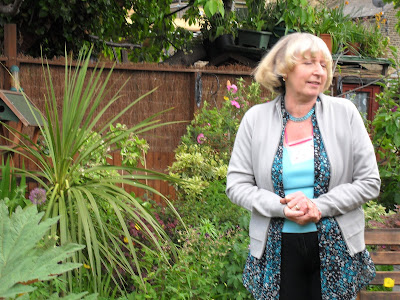


Janet in her garden


Friday, 21 May 2010

'Second Chance' by Janet Green


I picked this book up at a 'Book Swap' party and it proved to be a very enjoyable and entertaining read. The book is 'Second Chance' by Janet Green, Penguin, 2008.
Also, there were a couple of coincidences. Firstly, the title ' Second Chance' bears the same name to a choir that I joined for a while, in Blackheath, Kent. Secondly, the book is set around school friends, of some 20 years ago, reuniting. I also had a reunion with some of my school friends a year or so ago!
The book explores these different school friends; what they had been doing with their lives; the experiences they had gone through; their jobs, careers, relationships etc.
It then looks at how they are coping with their current situations. Tom, for example, sadly dies, and they all had to cope with that/deal with that, as best they could. Holly does it by falling for his brother, Will (who reminded her of Tom). In the process of all this she leaves her husband Marcus, and then realises that actually Will isn't the one for her either! But it as a learning experience. She realises that her marriage was a big mistake, and now she has the time to think about what it would be best to do next.
Meanwhile, Paul and Anna are trying to have a baby but nothing is working. Whilst Olivia gets pregnant, but doesn't want the baby. Paul and Anna suggest that they adopt her baby; they said they would really like that. But in the end, Olivia has the baby and bonds with it. Saffron, the actress wants to make it big, but is finding it difficult to make the breakthrough. So, she turns to alcohol instead, and then has a bit of a fling with Marcus. That is the final straw for Holly, in regard to her marriage. Then, Saffron's relationship with the famous Pearce is cemented and the book ends with Pearce saying that he has been graced with a 'second chance'.
'Cosmopolitan' had this to say about the book (which I agree with):
"Will keep you entertained to the last page'
The author, Janet Green, is a former journalist of the Daily Express who gave up her job to write a real woman's story about being single in the city. This became her first novel, Straight Talking, and she has written several other novels since then. She has four children and lives in Connecticut. So the author has rather an interesting background as well, I thought. I am sure that many novelists turn real life situations into fiction. Douglas Kennedy remarked on the fact, for example, that he got much of the material for his novels from that messy thing called 'Life'!


Saturday, 15 May 2010

'The September Girls' by Maureen Lee


This was another enjoyable read - another Maureen Lee story that is set in Liverpool. In a stormy September night in 1920, two women from very different backgrounds (one very well-off and one very poor) give birth to two daughters - Cara and Sybil. 19 years later, Cara and Sybil come together when they both enlist and are stationed in Malta. The story, woven around these characters, is full of intrigues, twists and turns, love affairs, secrets, death, heartache and much else besides. It gives one a powerful sense of history and the great difficulties that people went through in war time periods.

Tuesday, 27 April 2010

'Taming the Beast' by Emily Maguire


I thought this book was going to simply and clearly explore the topic of teachers taking sexual advantage of children, and how this can affect children/young teenagers later in life. So it interested me. However, I was disappointed. Don't get me wrong, it did address these issues, but in a way that I really found very distasteful. After rampant sex and declarations of love, Mr Carr, the English teacher, goes abroad with his wife, and abandons the 14 year old school girl, Sarah Clark. Sarah was a very intelligent girl and they had lots of discussions about English literature together. This bit of the book was good, and there even some interesting quotes in it from English Literature But this was no way to treat a young, vulnerable girl, even though she claimed that she knew what she was doing. When he leaves her she becomes a nymphomaniac, having sex with anyone and everyone; she becomes completely obsessed by it all. She also smokes pot, and lives a hedonistic life in general (although does also continue with her studying). Finally, he returns having divorced his wife, and they get together again. But their love is always on the verge of destroying them, especially when the abusing, violent side starts to take a hold, and they draw blood from each other. There are some very positive reviews of the book on amazon, and on the front cover there is a quote from Matt Thorne, of the Independent saying that it was 'The best novel I've read all year.' It is well-written, it has to be said, and it kept me engaged to the end, but I also thought it really was a very sickening book and I wasn't sure whether I really wanted to continue reading it (even though I did). It is not a book I would recommend, but I decided to blog it - don't always have to be writing good reviews!